Every real estate business, from a single-project developer to a large builder group, eventually asks the same question: where do we even start with marketing? This real estate marketing checklist answers that. It walks through branding, website, SEO, ads, social media, AI search, and lead management in the order they actually need to happen, so nothing gets missed and nothing gets rushed.
Why Every Real Estate Business Needs a Marketing Checklist
Most real estate marketing plans fail for a simple reason. They chase trends instead of following a system.
One month it’s Instagram Reels. Next month it’s Google Ads. Then someone reads about ChatGPT and suddenly “AI search” becomes the priority. Nothing gets done properly, and leads stay unpredictable.
A checklist fixes this. It gives you a clear order to follow, so nothing important gets skipped and nothing gets over-invested either. This guide breaks real estate marketing into 12 practical checklists, and you can use it whether you’re launching a new project, running an existing brand, or auditing what’s already in place.
Real estate buyers today don’t make quick decisions. They research a project for weeks, sometimes months, before they ever call a sales team.
During that research window, a buyer touches your brand in many places. Your website, Google search results, Instagram page, a WhatsApp message, maybe even an AI chatbot answer. If even one of these touchpoints feels weak or inconsistent, trust drops.
A checklist keeps every touchpoint aligned. It also solves a problem most developers don’t talk about openly: marketing budgets get wasted on the wrong priorities because there’s no clear sequence to follow.
Here’s what a good checklist actually does for your business:
- Keeps your branding, website, and ads consistent across every platform
- Stops you from spending on ads before your website is ready to convert
- Makes sure your content works for both Google search and AI search tools
- Helps your team measure what’s working instead of guessing
- Gives new marketing hires or agencies a clear starting point
With that context set, let’s go step by step, starting with the foundation: how your brand is positioned before a single ad goes live.
1. Brand & Project Positioning Checklist

Buyers don’t just buy a flat or a plot. They buy into a story about who is building it and why they should trust that builder.
This is where most small and mid-sized developers lose the game. Their branding looks identical to five other projects in the same city. Same colours, same stock photos, same “luxury living” tagline.
A strong brand identity, clear project positioning, and a well-defined USP need to be in place before any campaign starts. Without them, even the best-funded ads end up promoting a project nobody can describe in one sentence. That’s the gap a dedicated real estate branding agency is built to close. Before any campaign starts, your positioning needs to answer one question clearly: why should a buyer choose this project over the next one on their shortlist?
Checklist:
- Define a clear unique selling point (location advantage, price, amenities, or builder reputation)
- Create a consistent visual identity — logo, colours, and typography used everywhere
- Write a project story that explains the vision, not just the specifications
- List your trust signals: RERA number, past project handovers, certifications, awards
- Make sure every team member and broker uses the same messaging
2. Real Estate Website Checklist

Your website is the one asset a buyer visits again and again during their research phase. If it loads slowly or feels outdated, buyers assume the project itself is outdated too.
That perception matters more than most developers realise. A buyer comparing three projects will silently rule one out simply because the site felt clunky, even if the project itself was solid. A high-converting site comes down to a few things working together — fast mobile responsiveness, dedicated landing pages, simple lead forms, and an overall experience that doesn’t make a buyer think twice. That’s the specific focus of good real estate website development.
Checklist:
- Mobile-first design that loads in under 3 seconds
- Clear CTAs on every page — “Book a Site Visit,” “Download Brochure,” “Talk to Us”
- Project details, floor plans, and pricing easy to find, not buried in menus
- Trust elements: RERA number, testimonials, video walkthroughs
- Lead capture forms that ask for minimal information
- WhatsApp click-to-chat button visible on every page
3. Real Estate SEO Checklist

SEO is a long game, and that’s exactly why most developers underinvest in it. It doesn’t show results in week one, so it gets deprioritised in favour of paid ads.
But here’s the part that changes minds once developers see the numbers: a proper SEO strategy for real estate projects builds long-term organic traffic that keeps generating qualified property leads long after you stop actively working on a piece of content. A well-ranked blog post from a year ago can still be sending enquiries today, at zero extra cost.
Checklist:
- Target keywords buyers actually search — city name, project type, budget range
- Optimise title tags and meta descriptions for every page
- Fix technical issues: broken links, slow pages, missing schema markup
- Build location-specific landing pages for each city or micro-market you serve
- Publish content consistently, not in short bursts
4. Google Business Profile Checklist

Here’s a stat that surprises most developers: a large share of “near me” and city-specific property searches show a map pack before any website link. If your Google Business Profile isn’t optimised, you’re invisible in that map pack, no matter how good your SEO is.
Local visibility here depends on a mix of things — accurate business information, a verified Google Maps presence, and, most of all, customer reviews. Reviews specifically carry more weight than most developers assume, and exactly how they affect your local rankings is covered in how customer reviews impact local SEO rankings. This is one of the fastest wins on this entire checklist — it takes hours to set up, not weeks.
Checklist:
- Claim and verify your Google Business Profile
- Add accurate project address, contact number, and business hours
- Upload high-quality photos of the site, amenities, and sample flats
- Respond to every review, positive or negative
- Post regular updates: new tower launches, offers, possession milestones
5. Google Ads Checklist

Google Ads can put high-intent inquiries in front of a sales team within hours of going live. That speed is exactly why it’s also where budgets get burned the fastest, if it’s not set up right.
The biggest mistake we see: developers run ads pointing to their homepage instead of a dedicated landing page. A homepage tries to do everything. A landing page has one job — convert that specific visitor, and dedicated landing pages are consistently what improves ad conversions the most. What actually makes a real estate landing page convert is worth understanding before you spend a single rupee on clicks.
Checklist:
- Build campaigns around buyer intent — “3BHK in Gurgaon” performs differently than “luxury apartments Gurgaon”
- Use dedicated landing pages for each campaign, not your homepage
- Add negative keywords to filter out irrelevant clicks
- Set up call tracking and conversion tracking from day one
- Run retargeting ads for visitors who didn’t convert the first time
6. Social Media Marketing Checklist

Social media rarely closes a deal directly, but it does something equally important: it builds the familiarity that makes a buyer comfortable enough to click “Book a Site Visit.” Facebook, Instagram, and LinkedIn each play a different role here — Instagram builds visual brand awareness, LinkedIn works for investor and channel partner outreach, and Facebook still drives a large share of lead generation through forms and retargeting.
Most developers treat social media as a broadcast channel — post the brochure, post the offer, repeat. Buyers scroll past that content without a second look. What actually holds attention is behind-the-scenes content: construction progress, the team, the neighbourhood, real buyer stories.
Checklist:
- Choose 2–3 platforms based on where your buyers actually spend time
- Post a mix of content: project updates, educational tips, buyer FAQs, behind-the-scenes
- Use Reels and short videos for construction progress and site tours
- Respond to comments and DMs within a few hours, not days
- Run polls and Q&As to understand what buyers are curious about
7. Content Marketing Checklist

Content marketing is where SEO, AI search, and trust-building all meet. A well-written blog post does three jobs at once: it ranks on Google, it gets pulled into AI-generated answers, and it answers the exact question a hesitant buyer is asking at 11 PM.
The mistake to avoid is writing content that sounds like a brochure. Buyers can tell the difference between genuinely useful information and a sales pitch dressed up as a blog post.
Checklist:
- Answer real buyer questions: “Is this area good for investment,” “What documents do I need,” “Is RERA registration verified”
- Write in simple language — avoid real estate jargon your buyer won’t understand
- Add two internal links per article, connecting to relevant service or project pages
- Update older content instead of letting it go stale
- Include a clear next step at the end of every article
Good content compounds. A single well-ranked article can keep generating enquiries for years without any extra ad spend.
8. Email & WhatsApp Marketing Checklist

A buyer who fills your enquiry form but doesn’t book a site visit isn’t a lost lead. They’re a lead who needs a few more nudges before they’re ready.
This is where email and WhatsApp do the heavy lifting. WhatsApp especially works well in Indian real estate because buyers actually open and reply to messages there, unlike email, which often sits unread.
Checklist:
- Send an instant WhatsApp confirmation the moment someone submits an enquiry
- Set up a drip sequence: brochure, then floor plans, then site visit invite, then offer reminder
- Segment your list — first-time buyers, investors, NRI buyers each need different messaging
- Keep WhatsApp messages short and personal, not templated-sounding
- Use email for detailed updates: monthly newsletters, market reports, possession timelines
For NRI and overseas buyers specifically, time-zone-aware WhatsApp follow-ups often convert better than any other channel, since a quick reply builds trust faster than a scheduled call ever could.
9. AI Search Optimization Checklist

This is the newest section on any real estate checklist, and it’s the one most agencies still get wrong. Buyers are no longer only searching on Google. They’re asking ChatGPT, Gemini, and Perplexity questions like “best areas to invest in Gurgaon” or “which builder has the best track record in Noida” — and the way buyers discover real estate businesses online is shifting because of it. There’s a detailed breakdown of how real estate businesses can rank in AI search that covers exactly what this shift means for developers.
If your content isn’t structured for these tools to understand and quote, you simply won’t show up in those answers, no matter how good your traditional SEO is.
Checklist:
- Structure content with clear headings and direct answers, not long, wandering paragraphs
- Add FAQ sections that answer specific buyer questions in plain language
- Use schema markup so search engines and AI tools can read your content accurately
- Build topical authority — publish multiple articles around the same theme, not just one
- Keep facts and figures accurate and up to date, since AI tools favour recent, verifiable content
10. Lead Management Checklist

Generating leads is only half the job. What happens in the first 24 hours after a lead comes in often decides whether that lead converts or goes cold.
Most developers lose leads not because their marketing is weak, but because their follow-up process is. A lead sits unanswered for two days, and by then, that buyer has already booked a site visit with a competitor.
Checklist:
- Respond to every new lead within 15–30 minutes wherever possible
- Use a CRM to track every lead’s stage, not spreadsheets or scattered notes
- Score leads by intent — someone asking about pricing is closer to buying than someone just browsing
- Assign leads to specific team members so nothing falls through the cracks
- Review dead leads periodically — some just need a different offer or timing
Effective lead management is what improves your conversion rate after the inquiry has already come in — it’s the difference between generating leads that just sit in a spreadsheet and building a lead generation system that actually fills a sales pipeline.
11. Analytics & Performance Tracking Checklist
Everything on this checklist becomes guesswork without proper tracking. You can’t fix what you can’t measure, and in real estate marketing, small tracking gaps quietly waste large budgets.
Checklist:
- Track cost per lead (CPL) separately for each channel — SEO, Google Ads, social, referrals
- Monitor conversion rate from enquiry to site visit to booking, not just enquiry volume
- Review performance monthly, and do a deeper audit every quarter
- Compare this quarter’s numbers against the last one, not just against a fixed target
- Adjust budgets based on what the data shows, not what “feels” like it’s working
Numbers don’t lie, even when they’re uncomfortable. The projects that scale fastest are usually the ones where the team reviews this data honestly and reallocates budget accordingly.
Common Real Estate Marketing Mistakes to Avoid
Even with a checklist, certain mistakes show up again and again across developers of every size. Here are the ones worth watching for specifically:
- Running ads before the website converts. Traffic without a converting destination just burns budget.
- Copying competitor messaging instead of building real positioning. If every project in the area sounds the same, none of them stand out.
- Ignoring WhatsApp follow-ups. A buyer who doesn’t hear back within a day often moves on.
- Publishing content without an SEO plan behind it. Random blog posts rarely rank; consistent, connected content does.
- Skipping RERA and trust signals. Buyers actively look for these before trusting a project.
- Treating social platforms like a billboard instead of a conversation. One-way posting without engagement rarely builds trust.
- Not tracking ROI across ad spend and other channels. Without this, you can’t tell what’s actually working.
Most of these mistakes come from skipping a step, not from a lack of effort. That’s exactly what a checklist is meant to prevent.
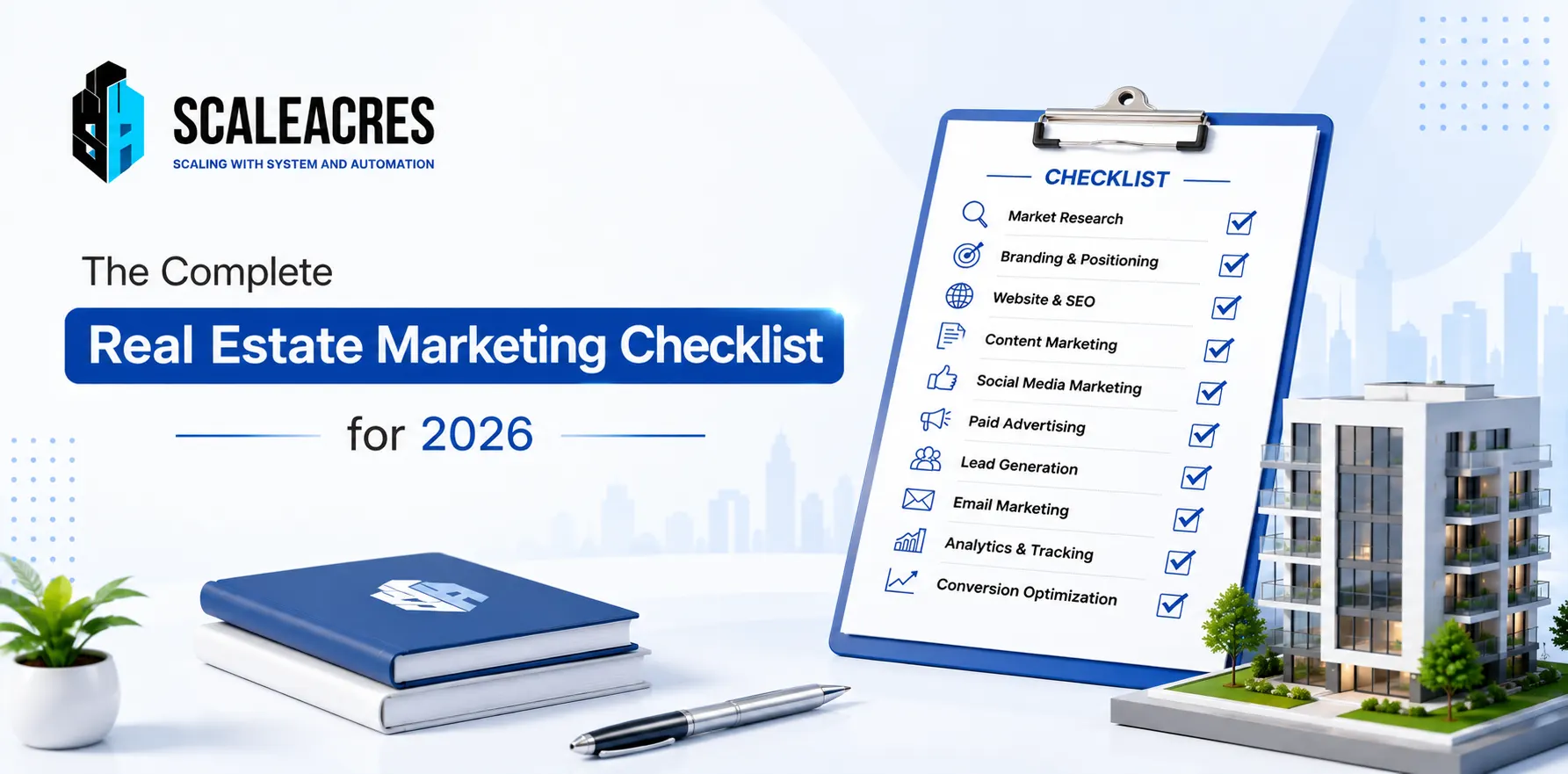
Your Complete Real Estate Marketing Checklist (Quick Reference)
A quick-scan version of everything above, for when you just need the list:
Branding
- Unique selling point defined
- Consistent visual identity
- Trust signals listed (RERA, certifications, past projects)
Website
- Mobile-first, fast-loading
- Clear CTAs on every page
- WhatsApp button visible
SEO
- Keyword-targeted pages
- Technical issues fixed
- Location-specific landing pages
Google Business Profile
- Claimed and verified
- Photos uploaded
- Reviews actively managed
Google Ads
- Dedicated landing pages per campaign
- Conversion tracking set up
- Retargeting campaigns running
Social Media
- Content calendar in place
- Mix of educational and project content
- Active response to comments/DMs
Content Marketing
- Buyer-question-focused articles
- Internal linking in place
- Older content updated regularly
Email & WhatsApp
- Instant WhatsApp confirmation on enquiry
- Drip sequences segmented by buyer type
- Regular newsletter updates
AI Search Optimization
- FAQ sections with direct answers
- Schema markup implemented
- Topical authority being built
Lead Management
- CRM in place
- Fast response times (15–30 min)
- Leads scored by intent
Analytics
- CPL tracked by channel
- Monthly and quarterly reviews
- Budget reallocated based on data
Frequently Asked Questions
What should I prioritise first in a real estate marketing checklist?
Start with branding and your website. Running ads or content campaigns before these are solid usually wastes budget, since traffic has nowhere good to convert.
How is real estate marketing different from marketing in other industries?
Real estate involves a longer decision cycle, higher buyer investment, and heavy reliance on trust signals like RERA compliance and past project delivery. Buyers research far more before making contact.
Is SEO or Google Ads more important for real estate?
Both work differently. Google Ads brings faster, short-term results, while SEO builds long-term, lower-cost lead flow. Most developers need both running together, not one instead of the other.
How often should I update my real estate marketing checklist?
Review it quarterly. Buyer behaviour, search algorithms, and platform trends shift often enough that a checklist from a year ago may already be missing newer channels like AI search.
Why does AI search optimization matter for real estate now?
Buyers increasingly ask AI tools direct questions about locations, builders, and investment potential. If your content isn’t structured for these tools to read and quote, you lose visibility in an entirely new discovery channel.
Do I need WhatsApp marketing if I already have email?
Yes. WhatsApp typically gets read and replied to faster than email, especially with Indian and NRI buyers who prefer quick, personal communication over formal emails.
Conclusion
Real estate marketing doesn’t need more tools or more channels. It needs a clear order to follow, so effort goes where it actually moves the needle.
Use this checklist as a working document. Revisit it every quarter, mark what’s done, and be honest about what’s still missing. That’s usually the difference between a project that struggles for leads and one that doesn’t.
For developers who’d rather have this executed end-to-end, a look at the full range of real estate marketing services covers everything from branding to AI search optimization, for projects across India and international markets.