Introduction
Buyers today don’t just “Google it” anymore. They ask questions — real, conversational questions — to AI tools like ChatGPT, Google AI Overviews, and Perplexity, long before they ever land on a website. “Which builder has 3BHK flats near [X] with a good resale value?” isn’t a search query anymore. It’s a conversation.
This is a big shift for real estate businesses. If your project isn’t showing up in these AI-generated answers, you’re invisible at the exact moment a buyer is deciding who to trust. Getting found in AI search isn’t about one trick or one plugin — it takes a mix of solid SEO, a fast and trustworthy website, useful content, and a system to turn that visibility into actual leads. That’s exactly the kind of full-picture work a real estate digital marketing agency is built to handle, so you’re not left guessing which piece to fix first.
In this guide, we’ll break down what AI search really is, whether you can actually rank in it, and the practical steps that help your real estate business get noticed — and trusted — by both search engines and AI platforms.
AI Search Is Changing Real Estate Marketing
For years, real estate marketing followed a simple formula: rank on Google, get clicks, get leads. That formula still works, but it’s no longer the whole story.
AI search platforms don’t just list links — they generate direct answers. Instead of showing ten blue links, they summarize information from multiple sources and hand the buyer one clean answer. If your content isn’t structured in a way AI can understand and trust, it simply won’t get pulled into that answer, no matter how good your project actually is.
This matters even more in real estate, where decisions involve big money and long-term trust. Buyers ask detailed questions — about locations, possession dates, RERA approval, amenities, and price trends — and AI tools are increasingly the first stop for those answers. Real estate businesses that adapt early will earn that trust before their competitors even notice the shift happened.
What Is AI Search?
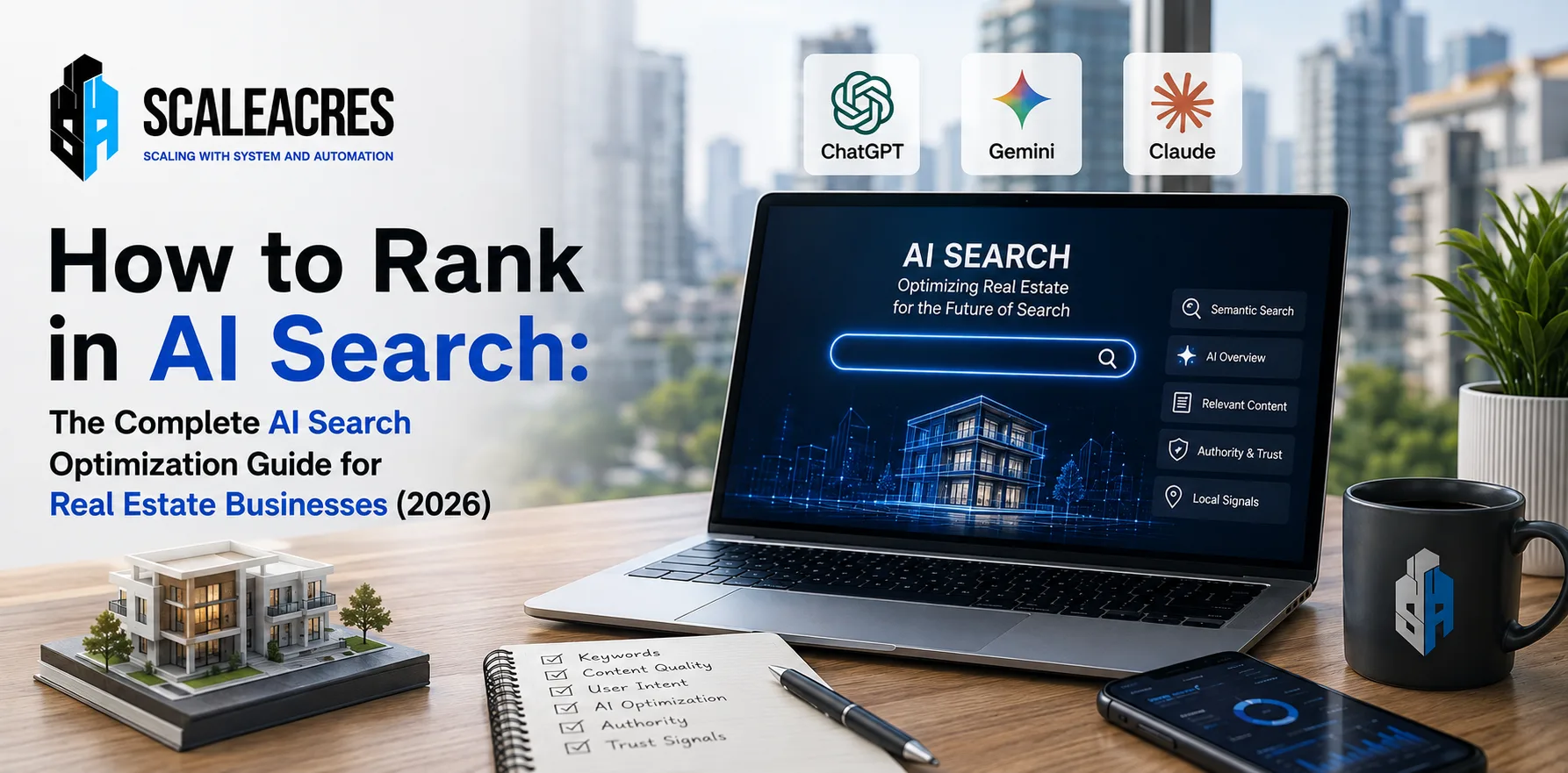
AI search is simply search powered by generative AI instead of a traditional list of results. When someone types or speaks a question into ChatGPT, Google’s AI Overviews, or Perplexity, the tool doesn’t just fetch pages — it reads, understands, and summarizes information from across the web to give one direct answer.
You’ll often hear two terms alongside this: AEO (Answer Engine Optimization) and GEO (Generative Engine Optimization).
- AEO is about structuring your content so AI tools can pull it out as a direct, ready-to-use answer.
- GEO is broader — it’s about building your overall online presence (your website, reviews, listings, mentions across other sites) so AI systems see you as a credible source worth citing.
Put simply: SEO helps you rank on a results page. AEO and GEO help you become the answer itself.
Can You Really Rank in AI Search?
Here’s the honest answer: yes, but only if your traditional SEO foundation is already solid. AI tools tend to trust and reference websites that are already doing well in regular search — they don’t invent trust from nothing.
If buyers already struggle to find your project on Google, AI platforms are even less likely to treat your website as a reliable source. This is often the real starting point, not the AI part. We’ve written in detail about why buyers can’t find your project on Google and the common, fixable reasons behind it — things like weak on-page SEO, missing location pages, or thin content that doesn’t answer real buyer questions.
Fixing these basics does double duty. It improves your regular search rankings today, and it builds the exact kind of foundation AI search tools need to trust and cite you tomorrow.
AI Search Optimization Strategies
Once your SEO basics are solid, here’s what actually moves the needle for AI visibility in real estate:
1. Answer real buyer questions directly Write content the way buyers actually ask questions — “Is this area good for investment?”, “What’s the possession timeline?”, “Is this project RERA registered?” Give a clear, short answer near the top of the page, then go deeper below it.
2. Use structured data (schema markup) Schema tags tell AI systems exactly what your content means — this is a property listing, this is a price, this is an FAQ. Without this, AI systems have to guess, and vague content usually gets skipped.
3. Keep your business information consistent everywhere Your project name, address, RERA number, and contact details should match exactly across your website, Google Business Profile, and listing portals. Inconsistent information makes AI systems less confident about citing you.
4. Build a technically strong, fast website Content alone won’t carry you. AI systems favor websites that load quickly, work smoothly on mobile, and are easy to crawl. A professional team offering real estate website development services can build this technical foundation properly, so your content actually has a chance to be seen.
5. Don’t ignore speed and security Site speed isn’t just about impatient users — it directly affects whether AI crawlers and search engines trust your site. HTTPS, strong Core Web Vitals, and good security practices all send trust signals.
6. Show real expertise, experience, and trustworthiness (E-E-A-T) AI systems, like search engines, favor content that shows genuine first-hand knowledge — real project details, real photos, honest pricing information, and clear author or company credentials. Avoid vague, generic descriptions. Specific, verifiable details build trust that both readers and AI systems can pick up on.
Turning AI Visibility into Qualified Traffic
Showing up in an AI-generated answer feels great, but it’s not the finish line — it’s the starting point. The real win is turning that visibility into people who actually enquire, visit a site, or book a call.
This means thinking beyond “getting found” and into “getting chosen.” Your content needs to guide that curious AI-search visitor toward an action, not just information. Our guide on how to use AI for real estate lead generation breaks down practical ways developers are already using AI tools to attract, warm up, and convert these high-intent buyers — instead of letting that AI-driven traffic quietly bounce off the homepage.
Converting AI Traffic into Qualified Leads
Once a buyer clicks through from an AI-generated answer, they’re usually already interested — but they also expect fast, useful answers. If your website goes quiet at that moment, you lose them just as fast as you gained them.
This is where instant engagement matters most. AI-powered chatbots can greet that visitor, answer common questions, ask about budget or preferred location, and even schedule a site visit — all without making them wait for a callback. Learn more in how AI chatbots can qualify leads on your real estate website.
Of course, technology alone doesn’t close deals — it needs a system behind it. Pairing your AI search visibility with professional real estate lead generation services ensures that every visitor, whether they arrived through Google or an AI chatbot, is properly nurtured into a real, qualified opportunity.
AI Search Optimization Checklist
Before you wrap up, run through this quick checklist:
- Your website ranks reasonably well for core, traditional search terms
- Every page answers a clear, specific buyer question near the top
- FAQ and property schema markup is added to key pages
- Business name, address, and RERA details are consistent everywhere online
- Website loads fast and works well on mobile
- HTTPS and basic security practices are in place
- Content shows real, specific details — not vague, generic descriptions
- There’s a clear next step (chatbot, enquiry form, callback request) for visitors who land on your site
If you can tick most of these off, you’re already ahead of most real estate businesses still treating AI search as a “someday” problem.
Conclusion
AI search isn’t replacing traditional search — it’s building on top of it. The real estate businesses that will win over the next few years are the ones treating this as one connected system: strong SEO fundamentals, a fast and trustworthy website, genuinely helpful content, and a smooth path from “found by AI” to “converted into a lead.”
That’s a lot to manage alone, and it doesn’t have to be done piece by piece. Working with an experienced real estate digital marketing agency means all of these pieces — SEO, AEO, GEO, website performance, and lead generation — work together as one strategy, instead of five disconnected projects competing for your attention.
The buyers are already asking AI these questions. The only question left is whether your business is the one getting the answer.