“Great news,” says your agency on the monthly call. “Cost per lead is down from ₹600 to ₹350, and you got 50% more leads.”
Your sales head, sitting two seats away, is not smiling. “Half of them don’t pick up,” he says. “The rest only wanted a brochure.”
Both of them are telling the truth. That is the trouble with cost per lead. It is the first number most real estate developers see in a report, and the one that tells them the least about whether anything is actually selling. We see this gap often when we run real estate lead generation campaigns, and it is rarely a failure of the ads. It is a failure of the metric.
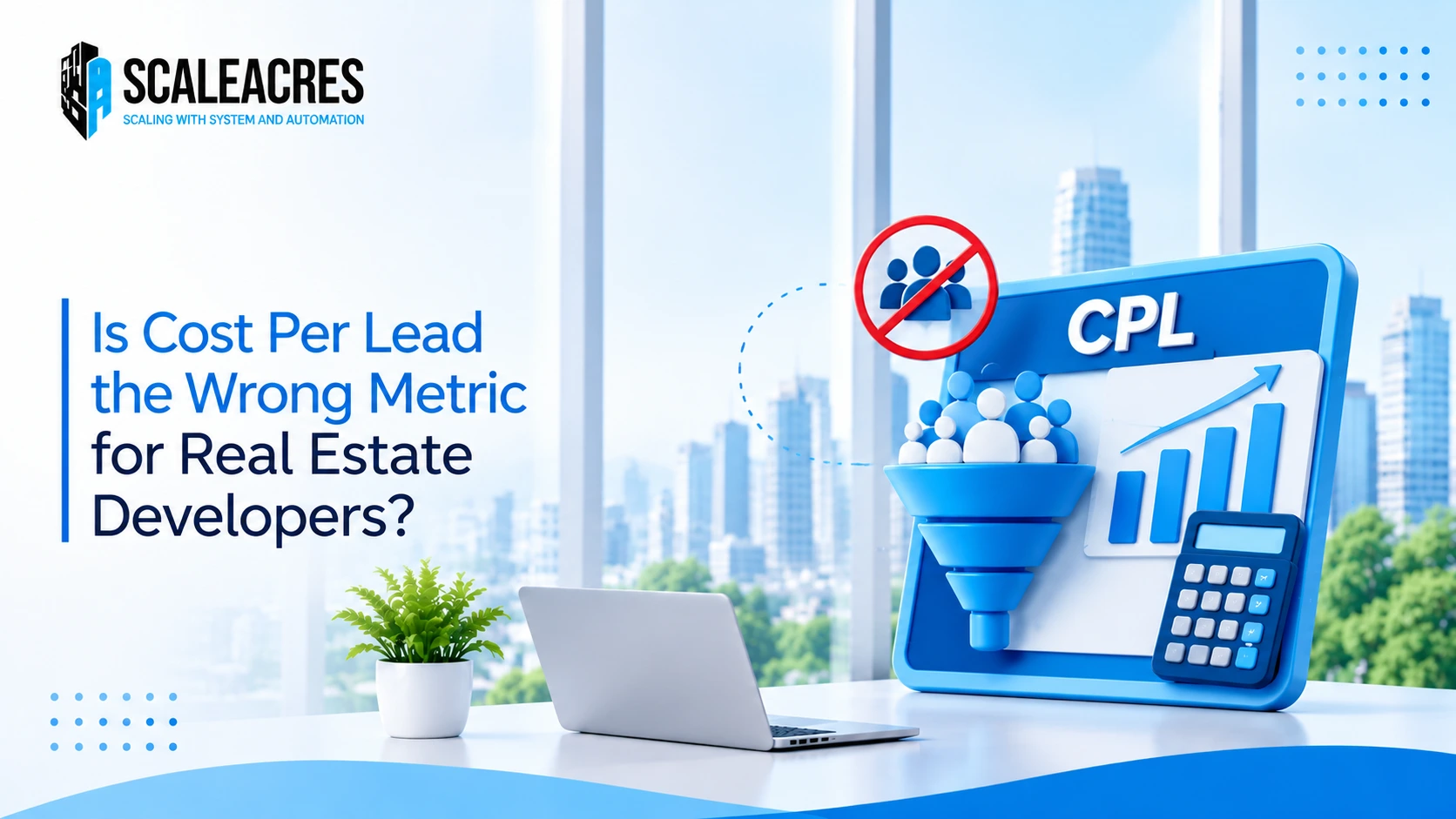
Yes, if it is the only number you track. Cost per lead (CPL) shows how cheaply a form was filled, not whether the buyer is serious. Real estate developers should also track cost per qualified lead, cost per site visit and cost per booking, because these connect ad spend to actual sales.
What Cost Per Lead Actually Measures
CPL is simple: total ad spend divided by the number of leads. That simplicity is why every dashboard leads with it.
But look at what it counts. A college student curious about prices, a broker fishing for your inventory and an NRI investor ready to pay a booking amount all become one identical “lead”. CPL cannot see budget, location preference or buying timeline. A metric that treats every enquiry as equal cannot tell you whether your marketing is working.
Why a Low CPL Can Hurt Your Sales
Cheap leads cost your sales team time
Every enquiry still needs a call, follow-ups and a CRM entry. If your telecallers spend most of the day on people who will never visit the site, the real cost shows up in salaries and in genuine buyers who were called too late.
Ad platforms chase the cheapest result
Platforms optimize for whatever you ask them to deliver. Ask a Meta ads campaign for the lowest CPL and it finds people who fill forms quickly, which is not always the group that buys homes. Short forms, giveaway-style creatives and broad targeting all push CPL down, and lead quality down with it.
Property sales cycles hide the damage
A lead generated today may take weeks or months to turn into a booking. A month of cheap leads can look like a win for a long time before the lack of bookings becomes visible. By then, the budget is already spent.
Two Campaigns, Same ₹3 Lakh
Here is an illustrative example, not client data. Say you spend ₹3,00,000 on each of two campaigns.
Campaign A has a CPL of ₹300, so you get 1,000 leads and a lovely report. But only 40 are qualified, 8 visit the site and 1 book. That is ₹37,500 per site visit and ₹3,00,000 per booking.
Campaign B has a CPL of ₹900, so you get just 333 leads. But 100 are qualified, 25 visit and 3 books. That is ₹12,000 per site visit and ₹1,00,000 per booking.
Campaign A wins the CPL report. Campaign B wins the quarter. If you paused B for being “three times more expensive”, you would have switched off your best campaign.
Metrics to Track Alongside Cost Per Lead
Cost per qualified lead
Agree on a written definition of “qualified” with your sales team: budget, location, property type and timeline. Then measure what each qualified lead costs. Smarter filtering helps too, and our guide to using AI for real estate lead generation shows how developers screen enquiries before a human picks up the phone.
CPQL = Total Ad Spend ÷ Number of Qualified Leads
Example: You spent ₹2,00,000 on ads this month, and 40 of the leads were qualified.
₹2,00,000 ÷ 40 = ₹5,000
So each qualified lead cost you ₹5,000.
Cost per site visit
A site visit is the strongest early signal of real intent, and it shows up within days rather than months.
CPSV = Total Ad Spend ÷ Number of Site Visits
Example: You spent ₹2,00,000 on ads this month, and 16 people visited your site.
₹2,00,000 ÷ 16 = ₹12,500
So each site visit cost you ₹12,500.
Cost per booking
This is the number your director cares about. It needs your sales team to tag every lead with its source in the CRM, but once that is in place, you can see exactly which campaign sells.
CPB = Total Ad Spend ÷ Number of Bookings
Example: You spent ₹2,00,000 on ads this month, and 2 of those leads booked a unit.
₹2,00,000 ÷ 2 = ₹1,00,000
So each booking cost you ₹1,00,000.
Lead-to-visit ratio and response time
If few leads turn into visits, the issue may be the follow-up rather than the ad. Responding within minutes makes a real difference, and our guide to WhatsApp follow-up strategies for real estate shows how to do it without sounding pushy.
Lead-to-Visit Ratio = (Site Visits ÷ Total Leads) × 100
Example: You got 100 leads this month, and 16 of them visited your site.
(16 ÷ 100) × 100 = 16%
So 16 out of every 100 leads turned into a site visit.
Response Time = Time of First Reply − Time the Lead Enquired
Example: A lead enquires at 11:00 AM and your team replies on WhatsApp at 11:04 AM.
11:04 − 11:00 = 4 minutes
How to Lower Your Real Cost per Booking
- Qualify at the form. Add a budget or configuration question. CPL may rise a little, but the leads that remain are more serious.
- Start direct conversations. Click-to-WhatsApp ads skip the form and open a chat, which helps your team judge intent faster.
- Fix the landing page. A slow website wastes your ad budget before the buyer even sees your project. Proper real estate website development fixes this at the root.
- Run project-wise campaigns. A separate campaign for each project avoids lead overlap and makes results easier to read.
- Build a search presence. Real estate SEO brings in buyers who are already searching, without paying for every click.
- Share CRM results with your agency. When your agency sees which leads visited and booked, it can optimize for those, not for cheap forms.
FAQs
Is cost per lead still useful for real estate developers?
Yes, as a health check. A sudden spike or drop in CPL can signal a problem with targeting, creatives or the landing page. It just should not be the only measure of success.
What is a good cost per lead for real estate in India?
There is no single number. It depends on the city, project segment, ticket size and channel. A better question is whether your cost per booking makes sense against the margin on a unit.
What is the difference between a lead and a qualified lead?
A lead is anyone who shares contact details. A qualified lead matches criteria your sales team has set, such as budget, location, property type and buying timeline.
How do I track cost per booking?
Tag every lead with its source, campaign and project in your CRM, and update the status through site visit and booking. Then divide each campaign’s spend by its bookings.
Should I pay my agency based on CPL?
CPL-only contracts can push an agency towards volume. Consider reporting on qualified leads and site visits as well, so both sides focus on sales outcomes.
Conclusion
Cost per lead is a useful signal, but a poor goal. It rewards volume while your business needs buyers. When you track cost per qualified lead, cost per site visit and cost per booking alongside it, you can see which campaigns actually sell.