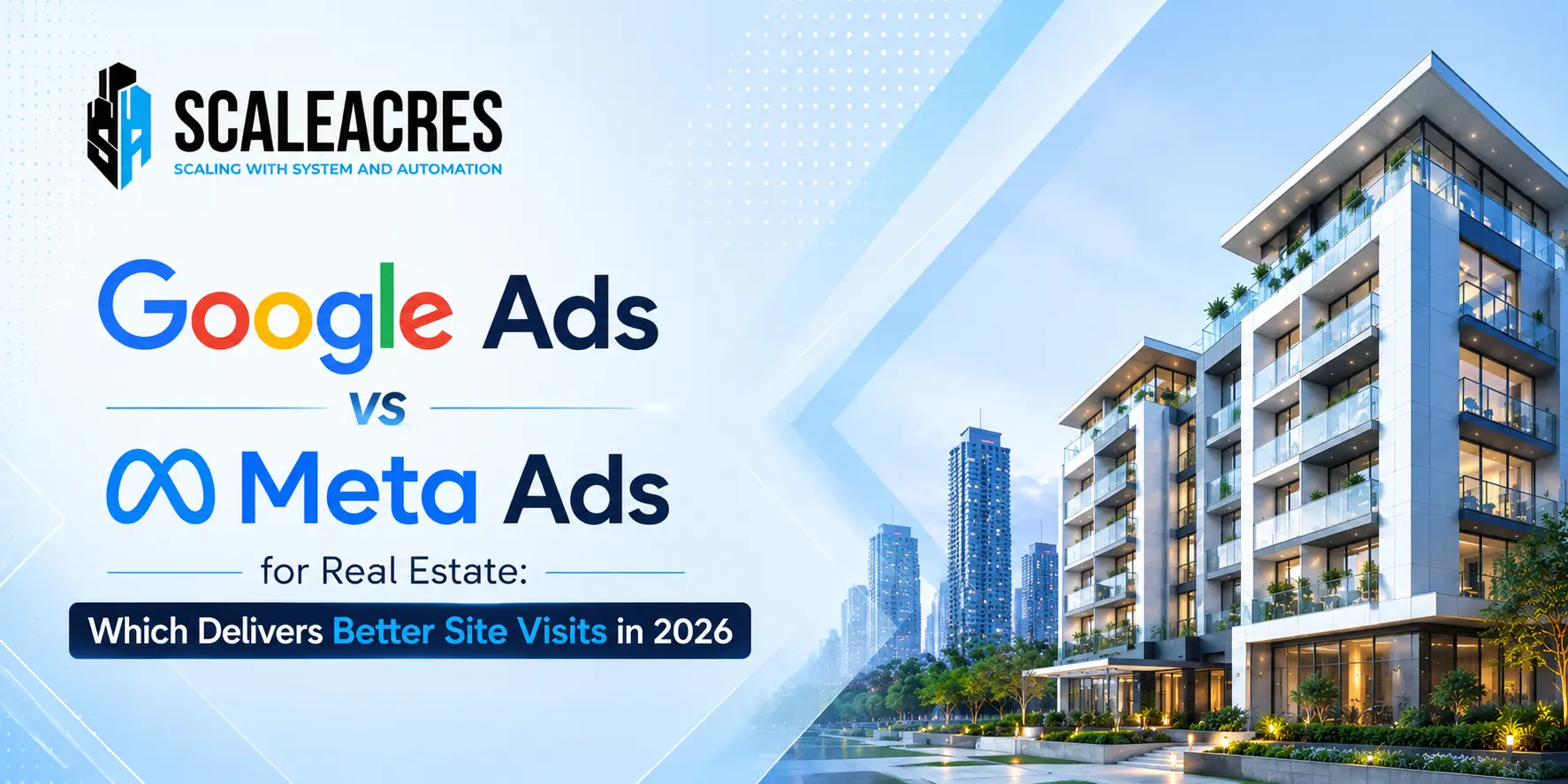
Two campaigns. Same budget. Same project. Wildly different results — and neither dashboard tells you why.
That’s the story I hear on repeat from developers and marketing heads right now. You pour money into Google Ads, watch the clicks roll in, and wait for a phone to ring that stays silent. Or you run Meta ads, rack up “leads” by the hundred, and discover half of them ghost the site visit entirely.
Neither platform is lying to you. They’re just answering completely different questions — and if you don’t know which question you’re asking, you’ll keep paying for the wrong answer.
First, Forget Everything You Know About “Leads”
Here’s an uncomfortable truth: a lead is not a customer, and a click is not a commitment. In real estate, the only number that pays your team’s salary is site visits that actually happen.
So before comparing platforms, it helps to picture how buyers actually move through their decision in 2026 — because it rarely follows a straight line anymore.
Most buyers first come across a project passively — a reel of a rooftop pool, a drone shot sweeping across a site, a carousel of floor plans — while scrolling with zero intent to buy that day. They don’t click. It barely registers consciously. Days or weeks later, once the idea has quietly taken root, they open Google and search something specific: the project name, or “3BHK ready to move [locality].” That’s when the real decision-making starts — and that’s usually when a form actually gets filled.
Notice what just happened there. Meta does the slow, invisible work of building familiarity. Google does the fast, decisive work of catching buyers the moment they’re ready to act. Run only Google ads, and you may never reach the buyer who didn’t yet know your project existed. Run only Meta ads, and you risk buyers staying “interested” forever, without ever being pushed toward action.
This is the whole game. Miss this, and every platform comparison you read will send you in circles.
When Google Ads Wins the Site-Visit Race
Google Ads is built for one moment: the moment someone already knows what they want and is actively hunting for it.
If you’re marketing a project in a location people already search for — an established suburb, a corridor with fresh metro news, a landmark everyone recognises — Google Search puts you directly in front of buyers at their most decisive moment. That’s about as close to “ready to visit” as paid advertising gets.
Google tends to outperform when:
- Your project sits in a location with genuine, existing search demand
- Speed matters — your team can follow up within minutes, because Search leads cool off fast
- You’re chasing NRI or relocating buyers who research heavily before ever picking up the phone
- You want to pull back website visitors who left without filling a form, through Display or YouTube remarketing
The catch? Search only works where search volume exists. If your project just launched and literally nobody is typing its name into Google yet, you’re bidding into silence. No amount of budget fixes zero demand.
When Meta Ads Wins the Site-Visit Race
Meta isn’t in the business of catching intent. It’s in the business of creating it.
Think about how many genuinely qualified buyers aren’t searching for anything today — they’re just scrolling, half-distracted, until something visually arresting stops their thumb. That’s Meta’s superpower, and no keyword-based platform can replicate it.
Meta tends to outperform when:
- You’re pre-launch or early-launch, with awareness starting from zero
- Your creative — photos, video, drone footage — is genuinely strong (this decides more than any targeting setting ever will)
- You want tight, hyper-local reach around the physical project site
- You’re re-engaging people who watched a video or visited your page but haven’t converted yet
The honest downside: some of those leads are lukewarm. Someone tapping “interested” on a post at midnight isn’t the same as someone typing your project’s name into Google three weeks later. That’s not failure — that’s simply what early-funnel attention looks like. Judge it by the right yardstick.
The Mid-Launch Trap Almost Every Developer Falls Into
Here’s a pattern worth watching for. A project launches strong on Meta — great engagement, decent reach — but a month in, site visits have plateaued and the internal chatter starts: “Meta isn’t converting, let’s pull the budget.”
Nine times out of ten, that’s the wrong read. The visits didn’t stall because Meta failed. They stalled because there was no Google Search presence to catch the demand Meta had already created. The audience was warm and ready — there just wasn’t a net to catch them when they finally searched.
The fix isn’t abandoning one platform for the other. It’s sequencing them correctly:
- Pre-launch / early-launch: Weight the budget toward Meta to build recognition, with a light Google Search layer for anyone already aware of the location or builder.
- Mid-launch, inventory moving: Shift weight toward Google Search and remarketing — the audience is now searching, and that’s where the conversions live.
- Late-stage, clearing inventory: Lean hard on retargeting across both platforms, aimed at people who’ve already shown intent. This segment almost always delivers the lowest cost per site visit you’ll see all campaign.
Three Quiet Budget-Killers That Have Nothing to Do With the Platform
Before you shift a single rupee between Google and Meta, rule these out — because in practice, they’re the real culprit far more often than people expect:
- One landing page trying to serve two very different visitors. Someone who just discovered you on Meta and someone who searched your project by name on Google are in completely different mindsets. One generic page can’t speak to both.
- Slow follow-up killing high-intent leads. A Search lead called back in five hours instead of five minutes is often already touring a competitor’s site.
- A website that undersells the project. If your site doesn’t load fast, doesn’t rank for the searches your buyers are actually running, or makes it hard to book a visit, you’re bleeding out budget that both platforms worked hard to earn. This is usually where a proper SEO audit or a stronger website optimization pass pays for itself many times over.
So, Which One Should You Actually Choose?
Wrong question by now, probably — but here’s the honest, project-stage answer:
- Nobody’s heard of your project yet? Start with Meta. Build recognition first; Google has nothing to catch without it.
- Launching in an established, high-search-demand location? Lead with Google Search, and let Meta support through retargeting.
- Mid-launch with good engagement but flat site visits? This is almost always a sequencing gap, not a platform failure. Bring both in together.
The developers pulling ahead in 2026 aren’t the ones arguing about which platform is “better.” They’re the ones matching each platform to the exact stage their buyer is in — and pairing that with a lead management process fast enough to turn interest into an actual walk-through.
If your site visits aren’t matching what your ad spend should be delivering, it’s worth getting a proper read on where the real gap is. Sometimes it’s the media mix. More often, it’s what happens in the fifteen minutes after someone clicks. Our team’s real estate digital marketing services look at both — the platforms and everything downstream of them — so your budget actually turns into footfall, not just numbers on a dashboard.