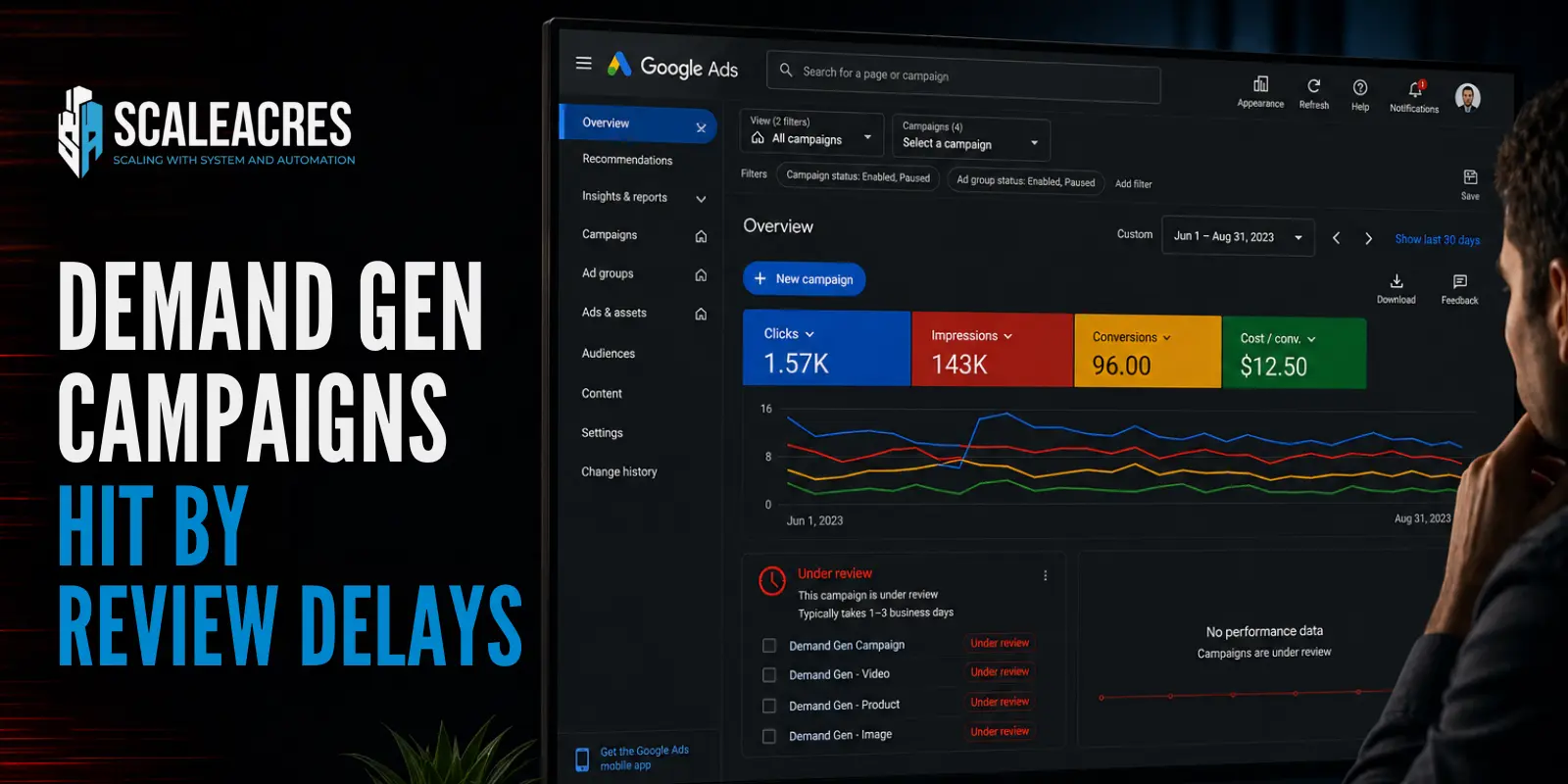
You launch a Google Ads Demand Gen campaign. Your creatives are ready, the budget is set, and targeting is dialled in. And then “nothing”. Your ads just sit there, frozen “In Review” status. A day passes. Then three. Then seven. No policy violations. No warnings. No clear explanation. If this sounds familiar, you are not alone.
Since late April 2026, a growing number of advertisers have reported that Demand Gen campaigns are stuck “in review” status for days at a time, across multiple accounts and industries, with no obvious reasons or warnings to explain the holdup.
What makes this more alarming is its selectivity, the issue appears isolated to Demand Gen campaigns, while other ad types like Search and Performance Max remain completely unaffected.
This article breaks down exactly what is happening, why it matters, and what you can do about it right now.
What Are Demand Gen Campaigns?
Before we dive into the problem, it’s worth recapping what Demand Gen campaigns are and why they matter so much to modern advertising strategies.
Demand Generation is Google’s AI-powered campaign type that is designed to reach users before they start searching. It captures engagement and drives action across YouTube (including Shorts), Discover, Gmail, and the Google Display Network, a surface where people browse, scroll, and watch rather than actively look for products.
Key Characteristics of Demand Gen Campaigns:
- AI-Powered Optimisation – Uses Google’s machine learning to automatically match the best creatives with the most relevant audiences.
- Multi-Format Creative – Supports image, video, and carousel ad formats, enabling rich and diverse storytelling across placements.
- Advanced Audience Targeting – You can use lookalike segments, remarketing lists, and intent signals to reach high-value, conversion-ready users.
- Full-Funnel Impact – Drives upper-funnel awareness while influencing branded searches, assisted conversions, and downstream purchase decisions.
What makes Demand Gen tick is speed and creative iteration. Advertisers constantly test images, videos, and audience combinations to learn what works. The faster you can launch and review creatives, the faster you can optimise.
That’s precisely why a review delay doesn’t just inconvenience, it breaks the entire campaign rhythm.
What’s Actually Happening? (The Problem Defined)
The issue first came to light when Matthew Skelton, a Senior PPC Specialist, took to LinkedIn with a question that quickly resonated across the advertising community:
“Google Ads friends, is anyone else seeing serious delays (I’m talking 7+ days) with ads stuck ‘in review’ for Demand Gen campaigns? I’m seeing this across multiple accounts and industries, with no obvious policy flags“
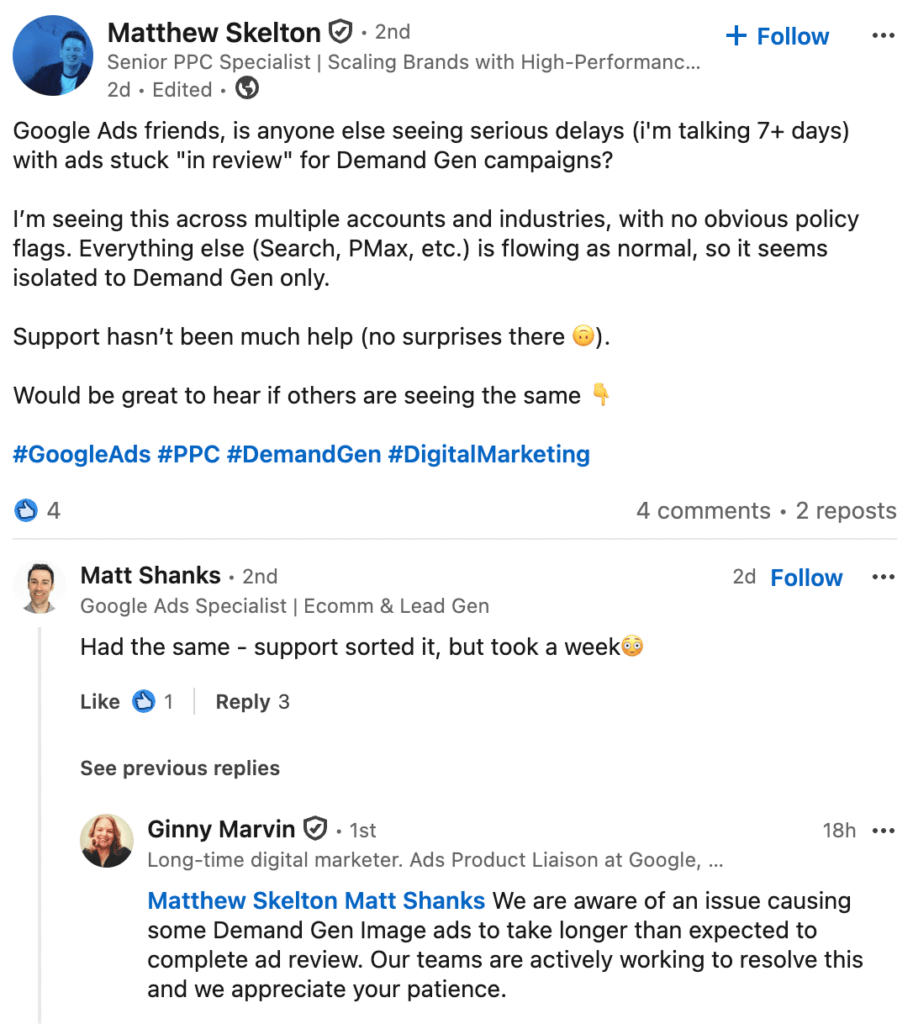
Source: LinkedIn
To put that in context, under normal circumstances, newly created or edited ads are typically reviewed within 1 to 2 days. What advertisers are experiencing right now is a delay three to five times beyond that, with no end date in sight.
Google’s Official Acknowledgement
When advertiser frustration began spilling publicly onto LinkedIn, it didn’t take long for Google to respond. Ginny Marvin, Google’s Ads Product Liaison, stepped into the thread directly. Her reply was brief but significant:
“We are aware of an issue causing some Demand Gen Image ads to take longer than expected to complete ad review. Our teams are actively working to resolve this and we appreciate your patience”
That’s it. No root cause. No timeline. No interim guidance.
Google’s teams are actively working on a fix, though no timeline has been shared. For advertisers managing live campaigns, that ambiguity is its own problem.
Here is what Google has and hasn’t said:
| What Google Confirmed | What Google Has Not Confirmed |
| The issue is real and platform-side | The root cause of the delays |
| Specific to Demand Gen Image ads | A resolution timeline |
| Engineering teams are actively on it | Whether delayed reviews restore automatically |
But what happens when you actually contact support
Public acknowledgements and actual support experience are two very different things. We found this out firsthand.
At Scaleacres Promotech, we manage performance advertising for real estate businesses, a sector where a single delayed campaign can mean a missed launch window or a stalled booking pipeline. So when we started noticing Demand Gen image ads stalling across multiple client accounts simultaneously, with no policy flags and no explanation, we didn’t wait for Google to announce something. We went straight to Google support to get answers.
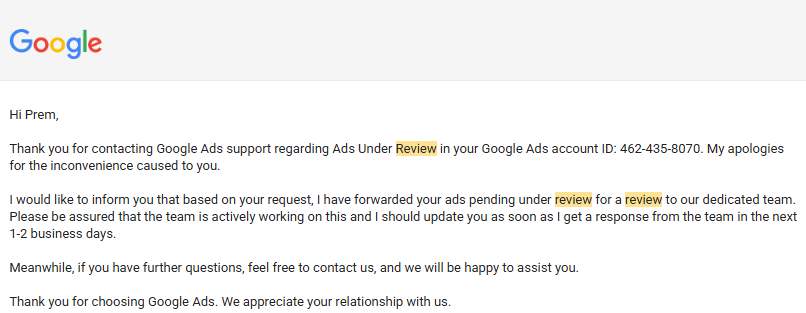
Google Ads support response – Email 1: Case escalated, resolution promised within 1–2 business days.
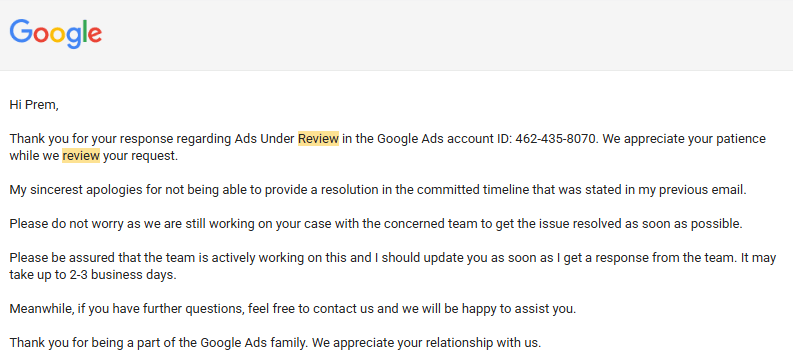
Google Ads support response – Email 2: Deadline missed, another 2–3 business days requested.
The follow-up email opened with an apology for missing the timeline they themselves had committed to. The team was still working on it. Another 2–3 business days were requested.
For our real estate clients, the impact showed up almost immediately. Campaigns that were supposed to pick up pace just… didn’t. Days passed, performance slowed, and the usual flow of leads started thinning out.
What made it harder wasn’t just the drop, it was the silence behind it. There was no clear issue to fix, no explanation to pass on. Just campaigns stuck in review, timelines slipping, and clients asking questions we didn’t have clean answers to.
Potential Reasons Behind the Google Ads Demand Gen Delays
1. The VAC → Demand Gen Forced Migration Flooded the Review Pipeline
This is the most likely trigger, and the timing makes it impossible to ignore.
Google completed the final forced migration of all remaining Video Action Campaigns to Demand Gen in April 2026. This wasn’t a gradual, voluntary shift. The biggest driver of Demand Gen adoption wasn’t that advertisers chose it, they were forced into it. Google eliminated the alternative, and Demand Gen became the only option.
As a result, thousands of advertisers who had never used Demand Gen were onboarded at once. They simultaneously uploaded image assets, launched new campaigns, and submitted ads for review. The review system, designed for steady, organic adoption, was likely not scaled for such a sudden surge.
The result is a bottleneck, not a bug in the traditional sense, but an infrastructure strain caused directly by Google’s own migration deadline.
2. Image Ad Review Is a Fundamentally Different and Slower Process
The delay is specific to image ads, not video. That distinction matters and points to a structural difference in how these formats are reviewed.
Google uses a combination of AI and human evaluation to review ads. Content where understanding the context of the ad is required is flagged for further review by trained operators and analysts.
Image ads, particularly new ones from newly migrated accounts, are more likely to require this human layer. Unlike Search ads, which are text-based and easier to assess algorithmically, image ads involve visual content moderation that includes checking for misleading imagery, brand safety, quality standards, and policy compliance across multiple surfaces, including YouTube, Discover, and Gmail simultaneously.
3. New Advertisers, New Signals — More Manual Scrutiny Required
A large share of current Demand Gen advertisers have been recently migrated, so Google has limited historical data on how these accounts perform within the Demand Gen format. Since enforcement systems are trained on past decisions, especially manual reviews, this lack of data weakens the AI’s confidence in making fast approvals.
In practical terms, newer Demand Gen accounts generate fewer reliable signals, causing more ads to be routed to manual review instead of automated clearance. When this happens at scale, as seen during mass migration, it significantly increases pressure on the review pipeline and slows overall approvals.
What You Can Do Right Now – Practical Solutions
Google hasn’t fixed the issue yet. But there are concrete steps you can take today to minimise disruption and keep campaigns moving.
1. Plan Launch Timelines With Buffer: Under normal conditions, newly created or edited ads are typically reviewed within one to two days. That benchmark is currently unreliable. Build your launch plans around a 7–10 day review window. Brief your stakeholders now, before a missed deadline creates a bigger internal problem than the delay itself.
2. Prioritise Your Most Important Creatives for Review First: Don’t submit everything at once. By sending high-priority campaigns first and delaying less important creatives, you increase the chances of faster approvals for what actually drives results, while avoiding unnecessary delays caused by queue congestion.
3. Consider Switching to Video Ads: Google’s official confirmation specifically references Demand Gen Image ads as the affected format. Video-based Demand Gen ads have not been reported as affected. If your creative assets allow it, testing video formats is worth considering, this is a logical inference based on available evidence, not a formally confirmed workaround from Google.
4. Don’t Make Unnecessary Changes: This is the most costly mistake advertisers are making right now. Every edit resets the review timer entirely, sending your ad back to the start of the queue. If your ad is already in review, leave it alone unless there is a clear, unavoidable reason to change it.
5. Pivot Budget Temporarily to Search or PMax While Waiting: Since other campaign types remain completely unaffected, exploring alternative ad formats can help mitigate disruption during the delay period. Redirect your Demand Gen budget temporarily toward Search or Performance Max to maintain visibility, keep spend on track, and protect campaign momentum while your image ads are under review.
6. Try Uploading a Fresh Creative as a New Ad: Editing an ad already in review resets the clock. But some advertisers have reported that uploading an entirely new creative as a separate ad, rather than modifying the existing one, can sometimes move through the queue faster. Do not replace or edit the stuck ad, let it continue in review. Think of it as placing a second bet, not moving your chips.
Conclusion
The Google Ads Demand Gen review delay is not a minor platform hiccup. It is a systemic problem, one that appears to be a direct consequence of Google forcing a massive advertiser base onto a single campaign type without ensuring the infrastructure could absorb the load.
For advertisers, the message is clear: this is not your account, not your creatives, and not your targeting issue. It is Google’s own problem, and right now, Google is still working on fixing it.
While Google has not officially given a timeline, you can plan for longer review windows, protect your most time-sensitive campaigns, avoid unnecessary edits, and shift budget toward formats that are still flowing normally.
Until Google provides a real fix and a real timeline, the only thing advertisers can control is how well they adapt and how quickly.
Frequently Asked Questions
Look at the questions people are asking about Demand Gen review delays:
1. What is causing Google Ads Demand Gen campaigns review delays?
While Google has not officially stated a single root cause, the most likely trigger is the forced migration of all Video Action Campaigns to Demand Gen in April 2026, which flooded the review pipeline with a massive surge of new image ads all at once.
2. Is this review delay affecting all Google Ads campaign types?
No. The issue is isolated specifically to Demand Gen image ads. Search and Performance Max campaigns are processing normally, confirming this is a Demand Gen-specific infrastructure problem, not a broader Google Ads outage.
3. How long does a Demand Gen ad normally take to get approved?
Under normal conditions, Google reviews newly created or edited ads within 1–2 business days. Currently, advertisers are reporting delays of 7 days or more with no clear resolution in sight.
4. Can review delays happen even when there are no policy issues?
Yes, and that is exactly what is happening now. Ads are sitting in review with zero policy violations or warnings. This is a platform-side bottleneck, not an account-level compliance problem.
5. Should I edit my Demand Gen campaign while it is sitting in review?
No. Every edit resets the review clock entirely, sending your ad back to the start of the queue. Unless absolutely necessary, leave the campaign untouched and let the review process complete.
6. What is the first thing I should check if the Demand Gen campaign is not running?
Check the Google Ads Status Dashboard first. If a platform-wide issue is confirmed there, stop troubleshooting your account settings, the problem is on Google’s side, not yours.